Showing posts with label Endangered elements. Show all posts
Showing posts with label Endangered elements. Show all posts
Wednesday, June 17, 2015
Endangered element: indium
Unlike others in the endangered element series, indium use is not dominated by a single application—indium is employed in a number of applications. For example, the screen you are looking at contains indium in the form of ITO—indium tin oxide—whose semi-conductive properties make it useful for controlling liquid-crystals. Indium semi-conductors are also useful for thin-film solar panels, LEDs, and electroluminescent materials. It is also found in solder, sodium vapor lamps, and nuclear control rods. Truly, it's a versatile metal.
However, indium is relatively rare. It comprises only 50 parts per billion (ppb) of the Earth's crust. One author compares indium with silver, claiming that silver is less abundant yet produced in higher quantities. However, silver comprises 70 ppb of the Earth's crust—still quite rare, but about as common as indium. Furthermore, silver is commonly found in ores, such as argentite. Indium minerals are uncommon. Instead, it is extracted from sphalerite—zinc ore—where it has a concentration of 1 to 100 parts per million. Fortunately, there has been substantial interest in finding substitutes for indium. Many of these solutions, however, still rely on non-renewable resources, like petrol chemicals or other endangered elements—e.g. gallium arsenide.

Wednesday, June 3, 2015
Endangered element: gallium
Gallium is a metallic element, well known for its low melting point—at 86 degrees Fahrenheit, it will melt in the palm of your hand. The mechanical properties of gallium make it unsuitable for most manufacturing processes. In fact, it is even known to weaken steel substantially. However, its chemical properties lend it to the production of semi-conducting materials. It is most commonly applied in compounds with arsenic—as gallium arsenide, GaAs—or nitrogen—as gallium nitride, GaN.
Three quarters of gallium is used in integrated circuits. Gallium arsenide is ideal for semi-conductors that are insensitive to overheating—that is to say, mobile technology, whose compact designs allow waste heat to accumulate. In the U.S., this accounts for the consumption of 30 tonnes of gallium each year. If the world consumed gallium at this rate, it would require 750 tonnes of gallium per year. World production capacity is estimated to be 680 tonnes per year. As more countries develop, it possible for demand to increase, potentially leading to shortages.
The demand for solar energy will also drive demand for gallium in the coming decades. In 2014, solar energy provided only 1% of Electricity in the United States. Photo-voltaic cells that are made with gallium can achieve high-efficiency. About 30%, compared to 20% efficiency of silicon based solar panels. In 2014, this required only 700 kilograms in the United States; however, a hundred-fold increase would push this to 70 tonnes. Again, if the entire world consumed gallium at this rate, the demand would be 1,750 tonnes. It is likely that a number of solutions will be needed to meet our energy needs.
Three quarters of gallium is used in integrated circuits. Gallium arsenide is ideal for semi-conductors that are insensitive to overheating—that is to say, mobile technology, whose compact designs allow waste heat to accumulate. In the U.S., this accounts for the consumption of 30 tonnes of gallium each year. If the world consumed gallium at this rate, it would require 750 tonnes of gallium per year. World production capacity is estimated to be 680 tonnes per year. As more countries develop, it possible for demand to increase, potentially leading to shortages.
The demand for solar energy will also drive demand for gallium in the coming decades. In 2014, solar energy provided only 1% of Electricity in the United States. Photo-voltaic cells that are made with gallium can achieve high-efficiency. About 30%, compared to 20% efficiency of silicon based solar panels. In 2014, this required only 700 kilograms in the United States; however, a hundred-fold increase would push this to 70 tonnes. Again, if the entire world consumed gallium at this rate, the demand would be 1,750 tonnes. It is likely that a number of solutions will be needed to meet our energy needs.

Friday, May 22, 2015
Endangered element: zinc
 |
| Sphalerite is the primary ore for zinc. |
Increased demand for zinc will likely be driven by zinc-air cells, useful for creating electric cars. In 2012, the United States used 26.7 quads—quadrillion BTUs—of energy for transportation, primarily supplied by petroleum. Zinc-air cells carry about 1600 BTU per kilogram—c.f. 43,000 BTU per kilogram for gasoline. To replace every conventional car on the road would require 17 billion tonnes of zinc-air cells. I don't know how much zinc is used to make these batteries, but there are only 1.9 billion tonnes of identified zinc resources in the world.

Can everyone in the world have an electric car? Probably not—but this answer is too dismissive. Everyone may not need to own a car in the coming decades. Greater availability to public transit and autonomous cars could substantially improve the efficiency of transportation. However, the United States only has 4% of the world population. Increased demand from the rest of the world—particularly developing nations—could offset any gains from improved efficiency. The future population of the world is uncertain as well. Some countries may experience growth in population; others may experience contraction in population. No single technology will likely be able to replace petroleum burning cars. Instead, societies will need to rely on a variety of solutions.
Tuesday, May 19, 2015
Endangered element: helium
In a previous post, I wrote about the concept of endangered elements—elements whose supply may not be able to meet demand within the next hundred years. If we expect certain technologies to improve and to reach ever more people, the scarcity of these elements could prove to be a major impediment. It's important to understand how we currently obtain and apply these materials. We'll begin with helium.
Most helium found on earth was produced through the nuclear decay of uranium—or other heavy elements—which then dissolved into natural gas and oil over millions of years. This isn't good news; most fossil fuel resources aren't projected to outlast the century, but bad policy making could produce shortages much sooner. Helium, despite being common in the cosmos, is rare on Earth, and in the atmosphere. It's effectively a non-renewable resource, and will be difficult to obtain once our current supplies run dry.
Helium has the lowest boiling point of any material at only 7 Fahrenheit degrees above absolute zero, which allows other objects in contact with liquid helium to be maintained at this temperature. The next lowest boiling point belongs to hydrogen—at 36 Fahrenheit degrees above absolute zero. Unsurprisingly, 32% of helium is used for cryogenics, particularly for cooling the magnets used in MRI machines. Unfortunately, this means that MRI may become less available as helium supplies dwindle. This could have a large impact on the standard of care, unless a substitute for MRI can be found. I suspect that this will be problematic for the widespread adoption of quantum computing technologies, as well. Such technologies my be adopted on a small scale, by wealthy institutions and organizations, but may remain beyond the reach of most.
Wednesday, May 13, 2015
Rare metals
Our society is dependent on an abundance of mineral resources. You are reading this today, because of a number of rare metals that have been used to construct the computer—or tablet, smart phone, etc. A large amount of time and effort is spent discovering, extracting, and transporting these materials from the Earth. Let's consider four of them: zinc, gallium, indium, and hafnium. These are example of so-called endangered elements.
As much as 95% of the Earth's crust is composed of silicates—minerals that contain silicon and oxygen. These minerals are not as suitable as the remaining 5% as ores, because the chemical bonds of silicates require more energy to be broken. However, even a pessimistic calculation estimates that there may be 10 quadrillion tonnes of non-silicates accessible to human mining efforts.
Ores are important for two reasons. First, they feature higher concentrations of certain elements than the rest of the Earth's crust—often, much higher concentrations. Second, their chemical purity make them suitable to industrial processes. Zinc is only the 25th most abundant element in the Earth's crust, but readily bonds with sulphur in an ore called sphalerite. It comprises 79 parts per million (ppm) of the Earth's crust, which is more abundant than silver, gold, or even copper. Gallium, indium, and hafnium are not typically obtained from unique ores, but occur in trace amounts in other metals. They are also substantially rarer at 17 ppm, 49 parts per billion (ppb), and 5 ppm, respectively.
These elements in particular have applications to technologies that will be important during the next century, and will likely experience growing demand in the face of dwindling supply—which would adversely affect their price, and the prices of technologiey.
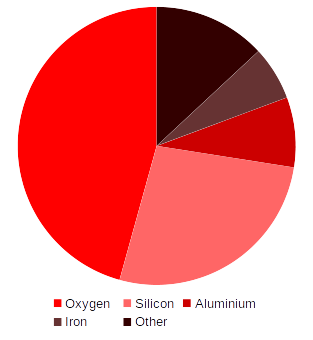 |
| Composition of the Earth's crust. |
Ores are important for two reasons. First, they feature higher concentrations of certain elements than the rest of the Earth's crust—often, much higher concentrations. Second, their chemical purity make them suitable to industrial processes. Zinc is only the 25th most abundant element in the Earth's crust, but readily bonds with sulphur in an ore called sphalerite. It comprises 79 parts per million (ppm) of the Earth's crust, which is more abundant than silver, gold, or even copper. Gallium, indium, and hafnium are not typically obtained from unique ores, but occur in trace amounts in other metals. They are also substantially rarer at 17 ppm, 49 parts per billion (ppb), and 5 ppm, respectively.
These elements in particular have applications to technologies that will be important during the next century, and will likely experience growing demand in the face of dwindling supply—which would adversely affect their price, and the prices of technologiey.
Subscribe to:
Posts (Atom)