Showing posts with label Zinc. Show all posts

Friday, May 22, 2015

Endangered element: zinc

Sphalerite is the primary ore for zinc.
Why is zinc an important mineral?  By far the most common use of zinc is corrosion resistance, accounting for 80% of the metal's use in the United States.  Steel has two useful properties; it's strong and light-weight.  It also has the disadvantage of being susceptible to rusting.  Stainless steel doesn't rust, but is substantially weaker than other kinds of steel.  Any steel structure that will be exposed to the elements needs to be protected from corrosion.  The solution to this problem is to simply coat the surface of the metal in zinc, which forms a layer of zinc carbonate over time.  This application, however, doesn't threaten future supplies.

Increased demand for zinc will likely be driven by zinc-air cells, useful for creating electric cars.  In 2012, the United States used 26.7 quads—quadrillion BTUs—of energy for transportation, primarily supplied by petroleum.  Zinc-air cells carry about 1600 BTU per kilogram—c.f. 43,000 BTU per kilogram for gasoline.  To replace every conventional car on the road would require 17 billion tonnes of zinc-air cells.  I don't know how much zinc is used to make these batteries, but there are only 1.9 billion tonnes of identified zinc resources in the world.

Can everyone in the world have an electric car?  Probably not—but this answer is too dismissive.  Everyone may not need to own a car in the coming decades.  Greater availability to public transit and autonomous cars could substantially improve the efficiency of transportation.  However, the United States only has 4% of the world population.  Increased demand from the rest of the world—particularly developing nations—could offset any gains from improved efficiency.  The future population of the world is uncertain as well.  Some countries may experience growth in population; others may experience contraction in population.  No single technology will likely be able to replace petroleum burning cars.  Instead, societies will need to rely on a variety of solutions.

Wednesday, May 13, 2015

Rare metals

Our society is dependent on an abundance of mineral resources.  You are reading this today, because of a number of rare metals that have been used to construct the computer—or tablet, smart phone, etc.  A large amount of time and effort is spent discovering, extracting, and transporting these materials from the Earth.  Let's consider four of them: zinc, gallium, indium, and hafnium.  These are example of so-called endangered elements.

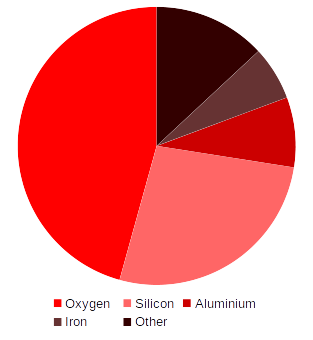
Composition of the Earth's crust.
As much as 95% of the Earth's crust is composed of silicates—minerals that contain silicon and oxygen.  These minerals are not as suitable as the remaining 5% as ores, because the chemical bonds of silicates require more energy to be broken.  However, even a pessimistic calculation estimates that there may be 10 quadrillion tonnes of non-silicates accessible to human mining efforts.

Ores are important for two reasons.  First, they feature higher concentrations of certain elements than the rest of the Earth's crust—often, much higher concentrations.  Second, their chemical purity make them suitable to industrial processes.  Zinc is only the 25th most abundant element in the Earth's crust, but readily bonds with sulphur in an ore called sphalerite.  It comprises 79 parts per million (ppm) of the Earth's crust, which is more abundant than silver, gold, or even copper.  Gallium, indium, and hafnium are not typically obtained from unique ores, but occur in trace amounts in other metals.  They are also substantially rarer at 17 ppm, 49 parts per billion (ppb), and 5 ppm, respectively.

These elements in particular have applications to technologies that will be important during the next century, and will likely experience growing demand in the face of dwindling supply—which would adversely affect their price, and the prices of technologiey.