Gallium is a metallic element, well known for its low melting point—at 86 degrees Fahrenheit, it will melt in the palm of your hand. The mechanical properties of gallium make it unsuitable for most manufacturing processes. In fact, it is even known to weaken steel substantially. However, its chemical properties lend it to the production of semi-conducting materials. It is most commonly applied in compounds with arsenic—as gallium arsenide, GaAs—or nitrogen—as gallium nitride, GaN.
Three quarters of gallium is used in integrated circuits. Gallium arsenide is ideal for semi-conductors that are insensitive to overheating—that is to say, mobile technology, whose compact designs allow waste heat to accumulate. In the U.S., this accounts for the consumption of 30 tonnes of gallium each year. If the world consumed gallium at this rate, it would require 750 tonnes of gallium per year. World production capacity is estimated to be 680 tonnes per year. As more countries develop, it possible for demand to increase, potentially leading to shortages.
The demand for solar energy will also drive demand for gallium in the coming decades. In 2014, solar energy provided only 1% of Electricity in the United States. Photo-voltaic cells that are made with gallium can achieve high-efficiency. About 30%, compared to 20% efficiency of silicon based solar panels. In 2014, this required only 700 kilograms in the United States; however, a hundred-fold increase would push this to 70 tonnes. Again, if the entire world consumed gallium at this rate, the demand would be 1,750 tonnes. It is likely that a number of solutions will be needed to meet our energy needs.
Showing posts with label Gallium. Show all posts
Showing posts with label Gallium. Show all posts
Wednesday, June 3, 2015


Wednesday, May 13, 2015
Rare metals
Our society is dependent on an abundance of mineral resources. You are reading this today, because of a number of rare metals that have been used to construct the computer—or tablet, smart phone, etc. A large amount of time and effort is spent discovering, extracting, and transporting these materials from the Earth. Let's consider four of them: zinc, gallium, indium, and hafnium. These are example of so-called endangered elements.
As much as 95% of the Earth's crust is composed of silicates—minerals that contain silicon and oxygen. These minerals are not as suitable as the remaining 5% as ores, because the chemical bonds of silicates require more energy to be broken. However, even a pessimistic calculation estimates that there may be 10 quadrillion tonnes of non-silicates accessible to human mining efforts.
Ores are important for two reasons. First, they feature higher concentrations of certain elements than the rest of the Earth's crust—often, much higher concentrations. Second, their chemical purity make them suitable to industrial processes. Zinc is only the 25th most abundant element in the Earth's crust, but readily bonds with sulphur in an ore called sphalerite. It comprises 79 parts per million (ppm) of the Earth's crust, which is more abundant than silver, gold, or even copper. Gallium, indium, and hafnium are not typically obtained from unique ores, but occur in trace amounts in other metals. They are also substantially rarer at 17 ppm, 49 parts per billion (ppb), and 5 ppm, respectively.
These elements in particular have applications to technologies that will be important during the next century, and will likely experience growing demand in the face of dwindling supply—which would adversely affect their price, and the prices of technologiey.
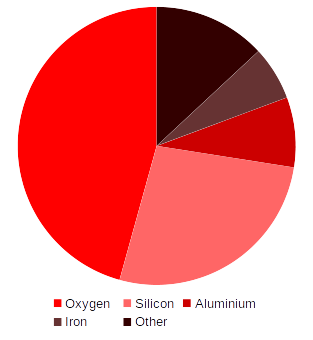 |
| Composition of the Earth's crust. |
Ores are important for two reasons. First, they feature higher concentrations of certain elements than the rest of the Earth's crust—often, much higher concentrations. Second, their chemical purity make them suitable to industrial processes. Zinc is only the 25th most abundant element in the Earth's crust, but readily bonds with sulphur in an ore called sphalerite. It comprises 79 parts per million (ppm) of the Earth's crust, which is more abundant than silver, gold, or even copper. Gallium, indium, and hafnium are not typically obtained from unique ores, but occur in trace amounts in other metals. They are also substantially rarer at 17 ppm, 49 parts per billion (ppb), and 5 ppm, respectively.
These elements in particular have applications to technologies that will be important during the next century, and will likely experience growing demand in the face of dwindling supply—which would adversely affect their price, and the prices of technologiey.
Subscribe to:
Posts (Atom)