Saturday, August 13, 2016

Electoral issue: drug use

Human cultures vary widely in the plants they use to gratify the desire for a change of mind, but all cultures... sanction at least one such plant and, just as invariably, strenuously forbid certain others. Along with the temptation seems to come the taboo.” — Michael Pollan, Botany of Desire

The question: Are you in favor of decriminalizing drug use?

Yes.

Before proceeding, I recommend taking a few minutes to watch School of Life's video "How to Use Drugs".  While it makes a strong case for a liberal attitude toward drug use, it employs an overgeneralized notion of what a drug is and fails to overcome prejudices against certain drugs.  Most of the posts I write are numberical, but this argument will be primarily philosophical.  There is evidence to believe prohibition does more harm than good, but my answer to this question is more a case against legislating cultural hegemony.

A drug is an external physical resource that intervenes directly in the brain to create benign and positive states of mind.  People use drugs of different kinds to experience different states of mind: alcohol to experience lowered inhibitions, nicotine to experience relaxation, caffeine to experience stimulation, cannabis to experience ataraxia, heroin to experience euphoria, LSD to experience hallucinations, etc.  All of these can—when used properly—create these positive states of mind.  It is abuse of drugs that leads to detrimental, addictive behaviors.

Laws—and therefore crimes—depend on the mores of the society they belong to.  Drug prohibition in the United States eventually became law due to increasing desire to regulate pharmaceuticals.  While wester civilization has a long standing history of alcohol consumption, over 450 years of tobacco smoking, and over 350 years of coffee drinking, other drugs were used largely for medicinal applications.  Heroin—like other opiates—cocaine and marijuana have historically been used for pain management.  Recreational use of these—and other—drugs was popular in other societies, and within subcultures of our own society, but have been subject to marginalization and stigmatization.  Consider the popular image of heroin users as hopelessly dependent on the substance from their first use.  In reality, 86% of heroin users will not develop an addiction, one in five of whom have been regular users.

There are also social costs of criminalizing drug use.  Over 48,000 prisoners in the United States are in prison for drug possession, while over 208,000 are in prison for all drug-related offenses.  Of these prisoners, 67% will be rearrested within three years of their initial release: 80% for non-violent offenses, but 20% for violent offenses.  The question of decriminalizing is, essentially, about whether we respect our citizens' rights to autonomy of their own minds and bodies.  Decriminalization will be the first step in achieving such a society, but the goal should be for the eventual legalization of drugs.

Tuesday, August 9, 2016

Electoral issue: military spending.

Every gun that is made, every warship launched, every rocket fired signifies in the final sense, a theft from those who hunger and are not fed, those who are cold and are not clothed. This world in arms is not spending money alone. It is spending the sweat of its laborers, the genius of its scientists, the hopes of its children. This is not a way of life at all in any true sense. Under the clouds of war, it is humanity hanging on a cross of iron.” ― Dwight D. Eisenhower 
The question: Should the government decrease military spending?

Yes.

While the United States has, arguably, the most powerful military in the world, it undoubtedly has the largest military budget in the world, larger than the next ten largest spenders on military in the world combined.  However, is this level of expenditure necessary?  To answer this question, I’ve collected data that compares the degree of militarization to the human development index and to the global terrorism index.  Of course, correlation does not imply causation, but it does waggle its eyebrows suggestively and gesture furtively while mouthing "look over there."  The data can be found in this spreadsheet.


In general, the data seems to indicate that the size of the both the size and relative strength of a military is only weakly correlated with higher levels of development, but this correlates moderately to greater prevalence of terrorist activity.  Consider, for example, the chart to the left.  It shows the global peace index vs. the human development index.  These two values have a correlation of −57%—noting that a smaller GPI indicates a more peaceful nation.  This seems to be expected, however, the peace index also takes into account the degree of militarization.  All this taken together, seems to suggest that there is some link between a lesser degree of militarization and a greater degree of prosperity.

This being said, what degree of demilitarization would be appropriate?  As a member of NATO, it is suggested that the United States puts 2% of its GDP towards military expenditures, which would amount to $358 billion.  Instead, the United States spends approximately $598 billion—based on 2015 figures—on its military.  If this recommendation was followed, the government would have $240 billion dollars to fund other programs, yet would still be two-and-a-half times as much as the second highest military spender—China—and more than the next four highest spenders combined.

Downsizing would neither be difficult, nor would it sacrifice the United States position as one of the strongest militaries in the world.  Simply spending at the NATO recommendation would represent approximately a 40% decrease.  A 40% decrease in the number of active military would imply a force of 890 thousand people—still the 4th largest in the world, and more congruent with our rank in population.  A similar decrease in the military equipment would imply: 6 aircraft carriers (1st) and 97 other warships, 3,580 tanks (2nd), 2,280 combat aircraft (1st), 4,200 nuclear warheads (2nd), etc.

This list almost indicates the absurdity of our level of spending, as a 40% doesn't actually affect our standing in any of these areas.  Meanwhile, there are other programs that are in great need of funding.  For example, the often cited ASCE estimate that $3.6 trillion is needed to improve our national infrastructure by 2020.  By downsizing our military, the government stands to save hundreds of billions of dollars, without negatively impacting our national security or our military strength.

Saturday, July 30, 2016

Electoral issue: minimum wage

The test of our progress is not whether we add more to the abundance of those who have much; it is whether we provide enough for those who have too little.” ― Franklin D. Roosevelt

It has been over a year since I have written for Weapons of Reason, before the presidential election had begun.  In the past, I always invited controversy.  Now, it is time to leave my door open to it.  isidewith.com has a quiz that compares your opinions on political issues with the candidates in the race.  I suggest everyone should use this resource to help to decide who to vote for in the election.  In the coming months, I will write about several of the issues that appear as questions.  I can only write about so many, though.  Every citizen should spend time investigating these issues.

I don't believe in suspense.  Assuming my position on these issues does not change radically, and you agree with these opinions, you should consider voting for either Hillary Clinton or Jill Stein.  I cannot be more specific than this, because I only have only answered the fifteen questions that I will write about.  You will have to answer the other questions based on your own judgement.

Question: Should the government raise the federal minimum wage?

Yes.

In the United States, 2.4 million workers over the age of 20 are paid at or below the federal minimum wage.  At the poverty threshold, wage earners in a typical American household earn $609 per person per month.  A typical household which consists of minimum wage earners provides only $584 per person per month.  An often cited reason for the minimum wage is the elimination of poverty among the poorest workers; however, it clearly is not succeeding in this goal.

An increase of as little as 5%to $7.61 per hourcould eliminate the discrepancy between minimum wage and poverty, but most proponents call for much greater increases.  For example, taking the increase in prices due to inflation into account, the minimum wage in 1980—$3.10 per hour—would be worth $9.07 per hour today, and the minimum wage in 1968—$1.60 per hour—would be worth $11.07 per hour.  In 2014, a coterie of six hundred economists called for the minimum wage to be raised to $10.10 per hour by 2016.  Of course, the 15Now campaign calls for the minimum wage to be increased to $15 per hour.

Neoclassical economics—the dominant school of economics—predicts that high minimum wage negatively affects employment.  The argument is, essentially, that the price of labor (wages) will equilibrate supply of labor and demand for labor.  A business looking to hire workers will offer the free market wage and will hire a number of workers—or rather, will purchase a number of hours of labor—until the amount of revenue generated by more labor equal the cost of purchasing that labor.  If the model is correct, this will maximize the profits of the business.  The argument is that artificially increasing the cost of purchasing labor will necessarily reduce employment.

However, there are some difficulties with this approach.  First, it assumes that there is no cost associated with rejecting a job offer.  This ignores the reality of opportunity cost and negative financial consequences associated with unemployment.  It is often the case that the employer has naturally greater bargaining power.  Second, the model assumes that all labor—or that all laborers—are interchangeable.  This also creates an inequality of bargaining power.  An unskilled laborer has the choice of spending time and money seeking training, but that worker doesn't have the ability to choose between a low-paying unskilled job and a higher-paying skilled job until those resources have been invested.  Furthermore, empirical studies have revealed that the economic effects of increasing the minimum wage tend to be benign, without negatively impacting employment, but also not showing conclusively positive effects.


That being said, the issue of raising the minimum wage.  Since the '70s, the income of American workers has been mostly stagnant, but productivity has nearly doubled.  The median income in 1973 was $12,050 per household.  If inflation is taken into account, but income were also distributed as equally as then, today's median income would be on the order of $130,000 per household.  Businesses derive profit from the disparity between productivity and wages, which has grown in the past decades.

Tuesday, July 7, 2015

Oil and doomsday

Recently, I provided an estimate of the amount of oil that was formed in the Earth—about 18 trillion barrels.  It's always good to tackle these kinds of problems from different angles, and before using the composition of the atmosphere to do the calculation, I had planned to re-purpose the doomsday argument.  It seems much better suited to this type of problem.  After all, there is a finite amount of oil—or, rather, a finite number of barrels of oil—that we are drawing from.

However, before we are able to apply the doomsday argument, we need to know how many barrels of oil have already been consumed. Using data from Energy Trends Insider, it appears that approximately 1.4 trillion barrels have been produced in modern history.  That being said, reliable verifications of this estimate are hard to find.


Using the doomsday argument, we find that we can be 94% confident that there are at most 16.6 trillion barrels of oil remaining, given that we have already consumed 1.4 trillion barrels.

Tuesday, June 30, 2015

Weapons of Reason: The paradox of skill

"The race is not to the swift or the battle to the strong, nor does food come to the wise or wealth to the brilliant or favor to the learned; but time and chance happen to them all." ― Ecclesiastes 9:11

Stephen Jay Gould is known not only for his work in biology, but also for a collection of essays on baseball.  In "Why No One Hits .400 Anymore," he explains just that, with a fairly elegant solution.  The pool of talent in baseball has grown since the early days, strategies and tactics have been improved, and players receive better training.  Another way of putting this is that the average skill among players has improved.  However, as they have improved, they are also beginning to approach the natural limits of what the human body is capable of.  When the entire community of players approach this limit, the community looses variation—there is now less room to spread out.
2009 Belmont Stakes photo finish.
This observation is sometimes called the paradox of skill—the greater the average skill level in a community, the less important skill becomes in determining the outcome of competition.  In the above photo finish, the difference between the two horses is only a few inches.  Both the horses were bread and trained to run competitively; however, the outcome was likely determined by essentially random factors that gave one horse a slight edge over the other.  This effect can be seen at work elsewhere.  At one time, higher education would have ensured employment in highly desirable, relatively low stress jobs.  Now, college education is becoming necessary for gainful employment at all.

Thursday, June 25, 2015

Population density

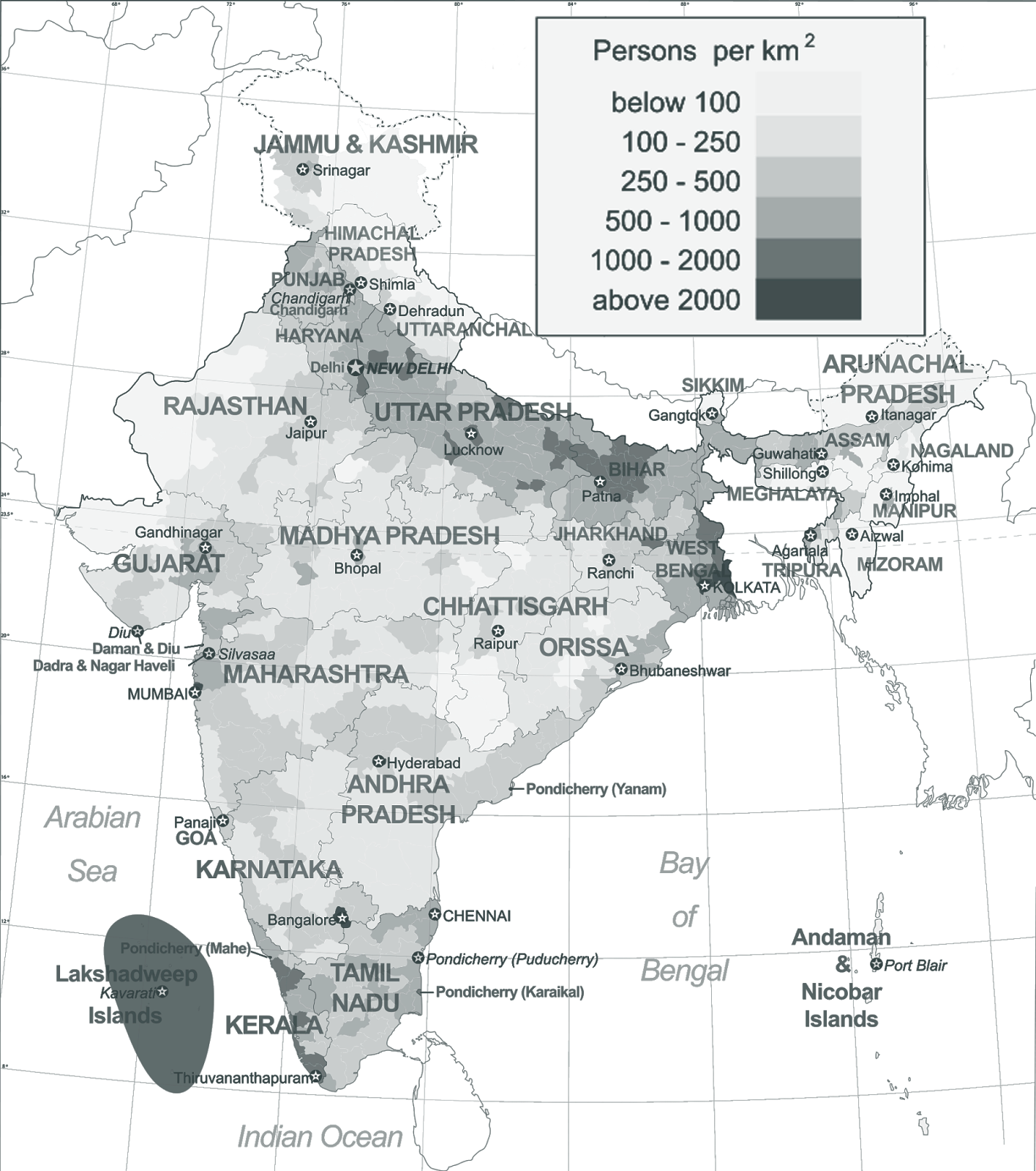
What would the population of the United States be, if it were as densely populated as India?  I was under the impression that India's population density is only slightly greater than that of the U.S.  This assumption is wrong.
The answer to the question is 4 billion people.  When will this happen?  The quick way to answer this question is to consider historical growth rates.  During the 20th century, the U.S. averaged 1.3% population growth per year.  At this rate, population would reach 4 billion by the year 2210. A lot can happen in 200 years to affect the actual growth rate.  That being said, the U.S. may reach a population of 1 billion—the equivalent of the population density of Europe—by the year 2100 at a 1.3% growth rate.

Wednesday, June 24, 2015

Peak oil, part II

"It is sunlight in modified form which turns all the windmills and water wheels and the machinery which they drive. It is the energy derived from coal and petroleum (fossil sunlight) which propels our steam and gas engines, our locomotives and automobiles." ― John Harvey Kellogg
In a previous post, I wrote about peak oil—particularly that answering the question of how much oil is left is not easy.  That said, a new approach has occurred to me.  Oil and coal are the remains of ancient plants, formed 300 million years ago in the carboniferous period—C on the horizontal axis of the chart below.  The periods leading up to this saw the proliferation of plants, which removed massive amounts of carbon from the atmosphere.  At its peak, carbon dioxide made up 7000 parts per million (ppm) of the atmosphere, but today makes up only 180 ppm.  This carbon went somewhere, and for the most part it was sequestered in rocks as coal and oil.  A simple calculation puts the weight of this carbon to be 10 trillion tonnes.
How much is oil and how much is coal?  Consider the proven reserves of oil versus coal.  There are 190 billion tonnes of oil reserves, but there are 860 billion tonnes of coal reserves.  Assuming that this reflects their natural abundance, we'll assume that oil and coal are in a ratio of 5 to 1 of sequestered carbon.  This implies that there have been 3.6 trillion tonnes of oil and natural gas—18 trillion barrels—and 11 trillion tonnes of coal.

How long will this last?  As of 2015, 93 million barrels of oil are consumed per day—about 34 billion per year—which has grown by about 1% per year since the 1980s.  If this continues, there are 185 years of oil.  That being said, consumption must eventually stop growing and begin to decline—that is the notion of peak oil.  Instead, oil rations will eventually be put into effect, which could mean that oil will be here for centuries.  As for coal, 7.5 billion tonnes are consumed per year, growing by about 2% per year since the 1980s.  This implies a 170 year supply.  The same caveats apply.  Many things can change in this time, too.  It's still hard to say how long we will burn fossil fuels.

Tuesday, June 23, 2015

Guaranteed minimum income

"I care not how affluent some may be, provided that none be miserable in consequence of it." ― Thomas Paine, Agrarian Justice
The concept of guaranteed minimum income—GMI—is relatively self-explanatory.  The government would send periodic payments to households to guarantee a minimum income.  Let's suppose that a program was implemented in which, on average, every person received 6,800 dollars per person per year—this is approximately 100% of the poverty threshold—costing a total of 2.2 trillion dollars.  This program would be difficult to fund.  The government collected 3 trillion dollars in taxes in 2014, but that would probably change when the GMI program is implemented.

There are about 150 million jobs in the United States, which means each job provides, on average, 20,000 dollars in tax revenue.  However, GMI could render minimum wage obsolete.  A large number of jobs would open up, mostly unskilled positions paying a few dollars per hour.  How many is hard to say.  For the sake of argument, let's say a 70% decrease in minimum wage, would lead to a 10% increase in the number of jobs.  The net result would likely be a 66% decrease in taxable wages, if the GMI is not taxed.  Though dubious, my calculations suggest this would cause a 14% decrease in tax revenue.  That is, 2.5 trillion dollars, which would just about cover the costs of the program.

That's not to say that a similar program cannot be implemented.  Giving GMI payments to the bottom 20% of the population would cost less than half a trillion dollars annually—on par with current welfare spending.  Furthermore, solutions such as universal basic income have gained support from both left- and right-wing politicians.

Wednesday, June 17, 2015

Endangered element: indium


Unlike others in the endangered element series, indium use is not dominated by a single application—indium is employed in a number of applications.  For example, the screen you are looking at contains indium in the form of ITO—indium tin oxide—whose semi-conductive properties make it useful for controlling liquid-crystals.  Indium semi-conductors are also useful for thin-film solar panels, LEDs, and electroluminescent materials.  It is also found in solder, sodium vapor lamps, and nuclear control rods.  Truly, it's a versatile metal.

However, indium is relatively rare.  It comprises only 50 parts per billion (ppb) of the Earth's crust. One author compares indium with silver, claiming that silver is less abundant yet produced in higher quantities.  However, silver comprises 70 ppb of the Earth's crust—still quite rare, but about as common as indium.  Furthermore, silver is commonly found in ores, such as argentite.  Indium minerals are uncommon.  Instead, it is extracted from sphalerite—zinc ore—where it has a concentration of 1 to 100 parts per million.  Fortunately, there has been substantial interest in finding substitutes for indium.  Many of these solutions, however, still rely on non-renewable resources, like petrol chemicals or other endangered elements—e.g. gallium arsenide.

Tuesday, June 16, 2015

Cost of electricity

"Why, sir, there is every probability that you will soon be able to tax it." — Michael Faraday on the practical value of electricity
We are living in a period of extraordinarily cheap energy—but exactly how much does energy cost?  Fortunately, Open Energy Information—OpenEI—collected data on the costs for different forms of electricity production.  The problem is that different technologies incur different costs.  A coal plant requires a turbine to be built and maintained, but also require fuel.  Solar panels simply need to be constructed, but then collect energy from the sun without additional fuel inputs.  To take these differences into, we'll use a metric called the levelized cost of electricity—LCOE.  The LCOE is the present value of all the costs involved in operating the electrical plant.

Using the OpenEI data and U.S. energy data, we can compare the relative costs of the energy produced in 2011, for example.
Source LCOE
(USD/MWh)
%
Production
Cost
(b USD)
Hydropower 20 8.0 18.5
Coal,
unscrubbed
40 15.3 70.3
Coal,
scrubbed
50 30.6 175.9
Natural gas 50 19.7 113.4
Geothermal 60 0.4 2.9
Nuclear 60 21.1 145.3
Wind 60 3.0 20.6
Solar,
Photo-voltaic
200 0.4 12.3
Solar,
thermal
280 0.02 0.5
What inferences can be drawn from this?  First, we are likely to use primarily coal  and natural gas power for a long time—they are among the cheapest on the list.  However, because they are so low, they are more likely to increase than to decrease.  This could be driven by increasing fuel prices, but this is likely decades away.  Solar power—particularly, photo-voltaic solar power—could still decrease substantially in cost per megawatt-hour.  It is much easier to go from 200 dollars per MWh to 100 dollars per MWh than it is to go from 20 dollars per MWh to 10 dollars per MWh.  The technology to make cheap solar energy available may soon be widely available.

Thursday, June 11, 2015

Peak oil

"Life without oil, in fact, would be so different that it is frightening to contemplate. We are addicted, and it is no comfortable addiction. Like other drugs, oil comes with a baggage of greed, crime and filth. Worse, it is smothering the planet."  ― James Buchan
Petroleum is a non-renewable resource. The question we need to ask is just how much is left?  A 2013 OPEC report estimated that there are 1.5 trillion barrels of oil in proven reserves in the world.  At the rate the world consumes oil, this will be gone in only 44 years.  In 2014, BP released a report putting the figure at 1.7 trillion barrels, claiming that this will last 53 years.  New oil is continually being discovered, though—oil companies have an incentive to find these new resources.  How long we can keep discovering new oil, however, isn't clear.
Source data via OPEC.
Understanding this chart is difficult—not what it says, but why it says it.  This requires a more detailed study of the history of oil production and the technologies that have driven discovery.  In the past, intermittent bursts of discovery seem to have been the norm.  This appears to have changed in the 1990s, with a lull that has lasted until the present—I am most interested in finding out why.  However, the size of the earth is finite.  The oil we have already found is low hanging fruit—the remaining oil will be difficult to find.  In addition to slowing rates of discovery, the oil industry will also face increased competition from alternative energy and—one may hope—increased pressure from the public for environmental responsibility.  It is likely that the end of oil will not come from dwindling supplies, but from these other causes.

Tuesday, June 9, 2015

Livestock

"It may indeed be doubted, whether butcher's meat is any where a necessary of life." ― Adam Smith, The Wealth of Nations
Anti-microbial resistance poses a threat not only to public health, but also to the meat industry.  In recent years, the process of raising livestock has received some attention from the public.  In some cases this has inspired people to adopt a vegetarian—or vegan—diet, due to concerns over animal cruelty.  In order to meet the enormous demand for meat, farmers need to raise animals in a short amount of time and in as small a space as possible.  As a result, animals are raised in squalor and severely restricted in mobility, making them susceptible to disease.

Antibiotics are necessary to this process, but they are also often misused.  Antibiotics are administered in low doses to many animals to stimulate growth.  This means more meat, which means greater profits for processors.  However, this also creates an environment in which anti-microbial resistance can develop.  80% of antibiotics sold in the United States are sold for use in raising livestock.  This is unsurprising when you look at the numbers of animals kept in the United States: 100 million hogs, 250 million turkeys, 8.6 billion chickens, etc.  This contributes to drug-resistant infections in people, but it is likely to negatively impact the meat industry as well.


Policies could be put in place that curb the consumption of antibiotics.  Animals could also be raised with more space, proper food and exercise.  However, this would undoubtedly cause the prices of meat to rise as well.  Before the advent of industrial farming, meat was expensive.  For example, chickens were raised primarily for laying eggs.  There were no chicken farms.  As a result, poultry was expensive, and was only consumed occasionally.  The meat industry also makes extensive use of marketing—essentially manufacturing demand.  It's unlikely that consumers will change their habits; therefore, farmers are also unlikely to utilize different processes.

Wednesday, June 3, 2015

Endangered element: gallium

Gallium is a metallic element, well known for its low melting point—at 86 degrees Fahrenheit, it will melt in the palm of your hand.  The mechanical properties of gallium make it unsuitable for most manufacturing processes.  In fact, it is even known to weaken steel substantially.  However, its chemical properties lend it to the production of semi-conducting materials.  It is most commonly applied in compounds with arsenic—as gallium arsenide, GaAs—or nitrogen—as gallium nitride, GaN.

Three quarters of gallium is used in integrated circuits.  Gallium arsenide is ideal for semi-conductors that are insensitive to overheating—that is to say, mobile technology, whose compact designs allow waste heat to accumulate.  In the U.S., this accounts for the consumption of 30 tonnes of gallium each year.  If the world consumed gallium at this rate, it would require 750 tonnes of gallium per year.  World production capacity is estimated to be 680 tonnes per year.  As more countries develop, it possible for demand to increase, potentially leading to shortages.

The demand for solar energy will also drive demand for gallium in the coming decades.  In 2014, solar energy provided only 1% of Electricity in the United States.  Photo-voltaic cells that are made with gallium can achieve high-efficiency.  About 30%, compared to 20% efficiency of silicon based solar panels.  In 2014, this required only 700 kilograms in the United States; however, a hundred-fold increase would push this to 70 tonnes.  Again, if the entire world consumed gallium at this rate, the demand would be 1,750 tonnes.  It is likely that a number of solutions will be needed to meet our energy needs.

Tuesday, June 2, 2015

The doomsday argument

"Since after extinction no one will be present to take responsibility, we have to take full responsibility now."  ― Jonathan Schell, The Fate of the Earth
When will the last person be born?  The question is simple; the answer is difficult.  J.R. Gott tried to answer this question using Bayes' theorem and simple statistics.  The number of people who will be born is likely to be large.  But is it more likely that there will be one trillion people or two trillion?  We expect larger numbers to be less likely than smaller numbers.  We write $\text{Pr}(N) = k/N$ and $\text{Pr}(n) = k/n$, where N is the number of people that will ever be born and n is the number of people already born.  Furthermore, we'll assume that there is nothing special about our position in human history.  We were as likely to be born as the billionth or the hundred billionth person.  Mathematically, this is written $\text{Pr}(n|N)=1/N$.

The likelihood that there will be N people, given that we know there have been n people already—$\text{Pr}(N|n)$—is obtained from Bayes' theorem:$$\text{Pr}(N|n)=\frac{\text{Pr}(n|N) \times \text{Pr}(N)}{\text{Pr}(n)} = \frac{n}{N^2}$$From this, we can calculate the probability for upper bounds on the number N: $\text{Pr}(N \leq z)= \frac{z-n}{z}$.  The first modern census was not conducted until the 18th century, but we can estimate the number of people who have lived on Earth—it's on the order of 100 billion.  We can be 95% confident that there will be fewer than 2 trillion people.  Given that there are four births every second, this person will be born in 15 thousand years.

There are a number of objections that can be made against the doomsday argument on mathematical grounds; however, the biggest problem is that it fails to address the physical causes of extinction. Genetic mutations will continue to accumulate in human populations, perhaps causing h. sapiens to differentiate into new species.  Disasters may contribute to an early human extinction.  A 2008 report by the Future of Humanity Institute estimates a 1 in 5 chance of humans extinction before the year 2100.  Though, the methodology of this study is questionable.  The doomsday argument may be flawed, but it raises questions in mathematical inference, and has opened the door to managing the risks we face as a species.

Wednesday, May 27, 2015

Computers vs. peak oil


Computers have become entwined in our daily lives.  Imagine, if you can, a day in which you didn't interact with a computer in some form or another.  Media, communication, personal finance, and commerce have become reliant on these technologies for success.  Will personal computers remain so readily available to everyone indefinitely?  It is easy to extrapolate form past experiences.  Computers have become steadily cheaper and more powerful for decades, but there is no real guarantee that this trend will continue.  This has also been confined mostly to Western Europe and the Anglophone nations, with computers remaining widely unavailable in developing nations.
Petroleum is very important in the manufacturing of electronics.  Over 40% of the chemicals used for creating semi-conducting devices rely on petroleum in some aspect of their manufacturing.  It is true that in most of these cases substitutes exist, but we don't rely heavily on these substitutes for a reason—either they are more expensive or cannot meet current demands.  Without cheap petroleum, manufacturing of semi-conductors will also rise in price, which will adversely effect the supply of these machines.

The energy requirements for producing electronics is enormous.  For example, one study found that manufacturing a laptop requires between 3000 and 4000 megajoules of energy—the equivalent of 24 and 32 gallons of gasoline, respectively.  Furthermore, these products often contain plastic components, in an effort to reduce costs.  Plastic can be replaced with metals, such as aluminium—many high-end models already use these materials.  But, this increases the price of products, as metals are harder to shape than plastics and are more expensive, in general.

Personal computers will remain available, even as petroleum supply dwindles; however, it is reasonable to expect that the price of these machines will likely increase.  Businesses will continue to rely on computing to run efficient operations, and the wealthy may have access to personal computers.  However, the poor may have to rely on publicly available machines—such as those at libraries.  This may have the effect of widening the gap between these groups of people, contributing to greater levels of wealth inequality.

Tuesday, May 26, 2015

Population of the United States

Calculating the change in a population is easy:$$\text{Population change} = \text{Births} - \text{Deaths} + \text{Immigration} - \text{Emigration}$$ Estimating the number of births and deaths—and the effects of migration—in any given year is difficult.  The number of births can be estimated from the total fertility rate (TFR)—the average number of children a woman will have during her life time.  The number of deaths can be inferred from a life-table, like those used by actuaries.  I've put these statistics together into a simple model for forecasting populations.  Today, we'll look at two hypothetical futures—two assumptions about the behavior of people in the 21st century.
The darker line assumes a constant fertility rate, equal to that of 2012.  The lighter line assumes a decreasing fertility rate.
In the 1960s the United States entered  a period of relatively low fertility.  The population hasn't decreased, because of immigration.  In the past few years, approximately one million people have come to this country each year—compared to about four million births per year.  In the graph above, the darker line shows the expected population if the fertility rate and immigration continue as they were in 2012.  In this case, we would expect the population to level off by mid-century around 350 million people.

The United States has also experienced declining fertility since the mid 2000s.  The lighter line assumes that fertility will continue to fall to 1.4 by the year 2025—this fertility rate would be similar to that of South Korea today.  If you were born in the 1990s, it is likely that none of your children will be born during the 2040s—the decade where the curves diverge.  The parents of these children already exist though—they are young children today.  After this point, the population would decline rapidly, as those born near the end of the 20th century begin to age and die.  We currently face an aging population, but the effects would be much more pronounced in this scenario.

Monday, May 25, 2015

Schedule

After some thinking—and observing my viewing statistics—I have decided to eliminate two posts per week: Monday and Friday.  Posts will also come earlier in the day.  My hope is that this will benefit the quality and variety of my writing and increase reader engagement.

Until tomorrow.

Friday, May 22, 2015

Endangered element: zinc

Sphalerite is the primary ore for zinc.
Why is zinc an important mineral?  By far the most common use of zinc is corrosion resistance, accounting for 80% of the metal's use in the United States.  Steel has two useful properties; it's strong and light-weight.  It also has the disadvantage of being susceptible to rusting.  Stainless steel doesn't rust, but is substantially weaker than other kinds of steel.  Any steel structure that will be exposed to the elements needs to be protected from corrosion.  The solution to this problem is to simply coat the surface of the metal in zinc, which forms a layer of zinc carbonate over time.  This application, however, doesn't threaten future supplies.

Increased demand for zinc will likely be driven by zinc-air cells, useful for creating electric cars.  In 2012, the United States used 26.7 quads—quadrillion BTUs—of energy for transportation, primarily supplied by petroleum.  Zinc-air cells carry about 1600 BTU per kilogram—c.f. 43,000 BTU per kilogram for gasoline.  To replace every conventional car on the road would require 17 billion tonnes of zinc-air cells.  I don't know how much zinc is used to make these batteries, but there are only 1.9 billion tonnes of identified zinc resources in the world.

Can everyone in the world have an electric car?  Probably not—but this answer is too dismissive.  Everyone may not need to own a car in the coming decades.  Greater availability to public transit and autonomous cars could substantially improve the efficiency of transportation.  However, the United States only has 4% of the world population.  Increased demand from the rest of the world—particularly developing nations—could offset any gains from improved efficiency.  The future population of the world is uncertain as well.  Some countries may experience growth in population; others may experience contraction in population.  No single technology will likely be able to replace petroleum burning cars.  Instead, societies will need to rely on a variety of solutions.

Thursday, May 21, 2015

Hydrogen fuel cells

How much energy is needed to make each kilogram of gasoline?  This may sound like an unusual question, because we tend to think of gasoline as a source of energy.  When one kilogram of gasoline is burned it releases about 45 megajoules (MJ) of energy in the form of heat, that can then be converted into other forms of useful energy.  However, 9 MJ are needed to produce a kilogram of fuel.  Though this number is non-zero, the important point is that less energy goes into the fuel than is recovered from it.  This feature makes petroleum good as a fuel source, among other properties.

In a previous post, I wrote about the energy requirements of producing hydrogen.  Every kilogram of hydrogen contains roughly three times as much energy as a kilogram of petroleum—about 140 MJ.  Steam methane reformation requires 135 MJ per kilogram of hydrogen; this represents a net gain in energy, but a very small net gain.  Furthermore, it relies on the same non-renewable resources that it is meant to replace.  However, even if we rely on electrolysis to manufacture hydrogen, the fuel cells extract energy by performing the electrolysis reaction in the opposite direction.  That is to say, the energy recovered by fuel cells is the same as the energy used in manufacturing the fuel.  At best, this only allows electricity to be converted to a more portable form.

There are difficulties in making hydrogen portable, as well.  Because gasoline is relatively dense, it can carry a large amount of energy in a compact space.  Hydrogen pressurized to 5,000 psi, would occupy over eight times as much space as the equivalent amount of gasoline, at room temperature.  Instead, hydrogen is typically cooled to about −400 degrees Fahrenheit.  At this temperature, the same hydrogen would occupy a similar amount of space as gasoline, but this temperature would need to be maintained.  Gasoline can sit for years before being used, but hydrogen would likely need to be used shortly after it is brought to temperature.

Wednesday, May 20, 2015

Power of the brain

How much power does the human body use?  Evolution is less survival of the fittest, and more survival of the most efficient.  The calculation is simple.  A typical caloric intake is 2500 kilocalories—known simply as Calories, in the United States—per day.  This is the equivalent of 120 watts.  This is rather impressive.  You and I are kept alive with about as much power as in used by a standard incandescent light-bulb.  Furthermore, the brain only requires 20% of the body's energy usage, which comes—that is, 24 watts.
How does this compare to computers?  Personal computers use a modest 65 to 250 watts, but don't possess the ability to match the functions of the human mind.  Artificial intelligence is, for now, run on supercomputers.  For example, WATSON consumes 85 kilowatts—the equivalent of roughly 1,000 PCs.  Koomey's law is similar to Moore's law, but deals with the energy usage of computers.  It states that the number of calculations for every unit of energy doubles every one-and-a-half years.  A quick calculation shows that WATSON could match the human brain in energy usage by the 2030s.  These computers only mimic one aspect of human cognition, but how these technologies will be used remains uncertain—there are a number of possibilities I intend to explore more fully.

That being said, I'm confident that human minds are not at risk of obsolescence.  The human brain is incredibly efficient, and already possesses a powerful set of skills.  Furthermore, the problem solving capabilities of groups of people exceeds the sum of the parts.  What is not clear is the number of people who will be able to take part in these kinds of activities.